Wednesday, July 16, 2014

Soviet Storm

The series Soviet Storm, which can be found on YouTube, is a Russian series from a few years ago that has been adapted to English.  It tells the story of the Soviet war against Germany from beginning to end.

The war between Germany and the Soviets, or the Eastern Front as it is often referred to, is something that until recently has not gotten the attention it deserves.  With the end of the Cold War, the Soviet archives were opened for scholarly study, and more complete histories of the Eastern Front could be written.  These more complete histories have helped people take notice that the vast majority of German casualties were inflicted by the Soviets.  This has led many scholars to declare the victory over Germany an almost exclusively Soviet endeavor, but it seems to me this is a case of the pendulum swinging too far in the opposite direction from the previous glossing over of the Soviet contribution to the war.

The video embedded below is the third episode of the series, which focuses on the German conquest of Crimea.  It's an especially interesting one because it presents some of the missions carried out by the Soviet navy and air force.  The Eastern Front is almost always presented as exclusively being a land war.  It was interesting to see the contributions of the other branches of the Soviet armed forces, particularly the strategic bombing campaigns carried out by the Soviets against the Ploeisti oil fields.  The strategic bombing campaigns carried out by America and Britain get a lot of attention.  It was interesting to see how the Soviets carried out their own attacks, particularly against the Ploeisti, as the American  Operation Tidal Wave against the oil fields always seems to get a lot of attention in WW2 histories.


The Border Crisis

While reading all the news stories of Democratic governors (John Hickenlooper, Martin O'Malley, Deval Patrick) unwilling to take in the illegal immigrant children surging across the border, it's clear to me the political life cycle I described in the previous post carries over to this issue as well.

Tuesday, July 15, 2014

The Life Cycle of Liberal Issues

This story on how believers in climate change use more electricity then skeptics is getting a lot of play on certain blogs.  The story helps to highlight the modern day life cycle of liberals on political issues.

  1. Create a problem
  2. Be unwilling to do anything yourself to solve the problem
  3. Use your unwillingness to do anything to solve the problem as a reason for why government has to enforce coercive measures in order to solve the problem.
  4. Undertake coercive measures.
  5. Find a way to either exempt yourself from the above coercive measures, or find a way to have government alleviate the suffering it might cause you.


One interesting point about the linked study is it only looked at home electricity use.  It would be interesting to see how the carbon footprints from travel compare between believers and skeptics of climate change. Here, the liberal believers might look better as more liberals live in cities where there is ample public transportation.  Although, if this is true, it doesn't say a lot about their willingness to make conscious sacrifices.

Of course, what really interests climate change skeptics isn't how much the carbon footprints vary between believers and skeptics in the general population, but how the carbon footprint of the liberal elite compares to everyone else and even those in the same socioeconomic class who are skeptical of climate change. Although, here we don't need a study to tell us that many of the people who believe climate change will be the apocalypse  have enormous carbon footprints.

Monday, July 14, 2014

Canada Trip: Last days of conference

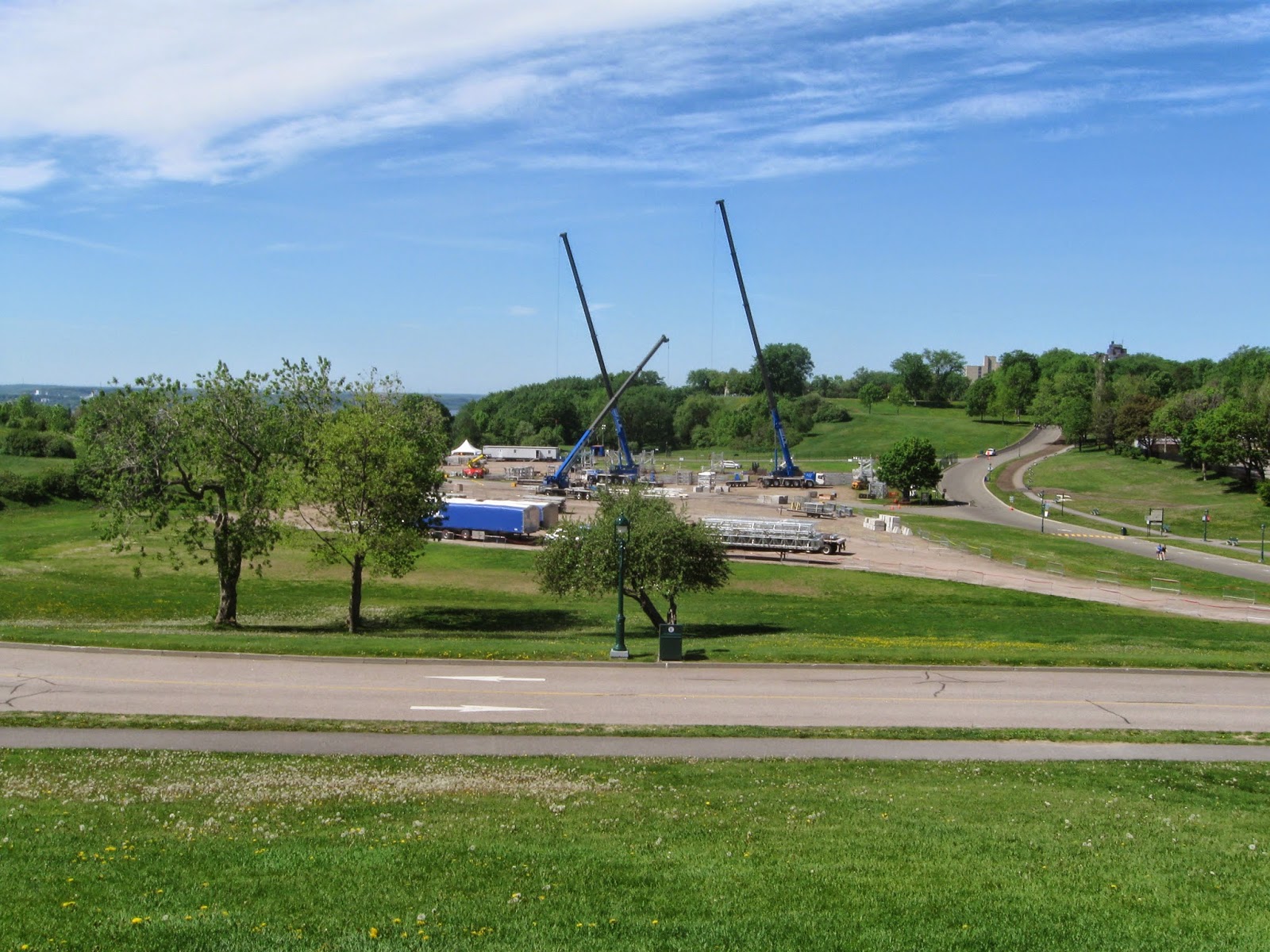
The conference I attended kept us pretty busy and didn't leave a lot of time for sight seeing, but I did skip some lectures here and there so I could see some of the city.  On Saturday morning I skipped the conference in the hopes of seeing the changing of the guard at the Citadel, only to find out it only occurred Monday through Friday at that time.  I still took the opportunity to walk around the outer edge of the city.  I started at the Plains of Abraham, the battlefield where the British defeated the French in 1759 during the Seven Years War.  This battle gave the British Quebec City and control of the St. Lawrence River, which eventually allowed them to conquer Canada.  Surprisingly, there was almost nothing to mark the spot, but this is currently being rectified as the Canadians are in the middle of building something on the site.

I walked along the river taking pictures constantly as I walked.  The view from the hills that encircle the city is just beautiful.  I walked from the Plains of Abraham to the area of Old Quebec that I visited on the first day I arrived in the city.

I finished up my walk that day by visiting the Basilica Cathedral Notre Dame.  The cathedral is currently celebrating its 350th anniversary, as described here.  In honor of the anniversary, a year of Jubilee was declared and a Holy Door was opened, the first one outside of Europe.  For those who don't know, walking through a Holy Door grants plenary indulgence, something that was a major plot point in the movie Dogma. I had no idea this was occurring when I made the decision to go to the conference.  I first learned about it from a story in the travel section of the local paper two months before my trip.  It was a very pleasant surprise.  Walking through the Holy Door was quite an experience, and the inside of the cathedral was ornately decorated and just beautiful.  It's just too bad the Holy Door is only open until this December.  I wish there was a more permanent door on this side of the Atlantic so more people could have the experience I did.


Tuesday, July 8, 2014

Canada Trip: Conference

The conference kept me pretty busy when I was in Quebec City.  They had talks and events going from sunrise to sunset most days.  The meal breaks and coffee breaks were long enough that I was able to take some time to walk around the immediate area by the congresscenter and do some sight seeing.  The center was near several old fortifications that surround the eastern portion of the city.  While they look medieval, I later found out they were surprisingly built around 1820.  Both the French and British apparently relied on makeshift fortifications despite all the wars in which Quebec City found itself invaded by a foreign army.  It was only after the American invasion of Canada during the War of 1812 that the British became willing to spend the money on the proper fortifications needed to guard Quebec and protect the opening of the St. Lawrence River.


On one of the nights when I walked around the congress center, there was an amazingly beautiful rainbow in the sky.  I got some amazing pictures of it, and I hope to blow up and frame the one shown below.

Friday, July 4, 2014

Canada Trip: Quebec City: Day 1

After spending a weekend in Toronto, I drove to Quebec City for my conference with a one night stopover in Montreal.  As I just needed a bed to sleep in for the night, I got a room at a hostel at the University of Montreal.  The place was hot, a bit dirty, and smelled of marijuana, but it was just a one night stay so I didn't mind.

I left the hostel early in the morning to get out of Montreal before the traffic got bad.  I made it to Quebec City in the late morning and had some time before I could check-in at the place I was staying, so I parked in Old Quebec City near the river.  It was in an area of shops and restaurants, so I walked around there most of the afternoon.  I got some pictures of the river, but am cursing myself now for not getting some shots of the streets themselves.  The only picture I really got was of a mural, shown below.  The place had a very European feel, both architecturally and culturally.  I saw a couple people greeting each other with the European double kiss on each cheek.

The welcoming reception for my conference was that night.  They had a couple Cirque du Soleil style acts to entertain us, one of which was a male aerialist, pictured below, who was just incredible.  We all marveled at the kind of strength it must take to do what he did.


Tuesday, July 1, 2014

Canada Trip: Toronto

Since I was so busy during my Canada trip itself, I didn't have time to blog about it.  I'm going to be doing so retroactively over the next week.

My first stop on my trip was Toronto.  I stayed in a hotel around the Ed Mirvish theater, where I saw the musical "Flashdance."  I later saw the play "The Last Confession," and will write up reviews of both later.  Besides seeing those two shows I did some general sight-seeing, and tried out a couple microbrews: 3 Brewers and Mill Street Brew Pub.

I had been to Toronto once before, back in 1997 on  a college trip to see "Phantom of the Opera."  I was impressed with the city back then, although, I hadn't seen too much of the city other then the area around the Rogers Center.  When I first arrived and was walking in the area around my hotel, I wondered what happened to the city as it was not nearly as nice as I remembered it.  I found out the next day the areas of the city I had seen before were just as nice and clean as I remembered.